
Key Insights
Technology is not Strategy: Buying SAP or Oracle is a procurement decision, not a competitive advantage. The "Shopping List" Trap: A roadmap tells you when you are spending money. A strategy tells you why that spending creates value. The 3-Step Fix: True Digital Strategy requires Diagnosis (What is the friction?), Guiding Policy (How do we deal with it?), and Coherent Action (The Roadmap).
The Scenario
I sat in a boardroom last week with a CIO who was visibly excited. He slid a 50-page, glossy-bound deck across the mahogany table with the weight of someone who believed they had just solved the company's future.
"This," he said, tapping the cover, "is our Digital Strategy for 2026."
I opened it. The graphics were beautiful. The timelines were precise. The budget was substantial.
Page 1: Upgrade core ERP to S/4HANA by Q3.
Page 2: Migrate on-premise data lakes to Azure.
Page 3: Implement Salesforce for the European sales division.
I flipped through ten more pages. It was more of the same: vendor names, licensing costs, and "Go-Live" dates.
I closed the deck and slid it back. The room went quiet.
"This isn't a strategy," I said gently but firmly. "This is a shopping list."
His smile faded. "We spent three months on this."
"You spent three months negotiating with vendors and planning logistics," I corrected. "But you haven’t answered the only question that matters: If we buy all of this, why will we win?"
This scenario isn't unique. It is the single most common failure point I see in my consultancy. Organizations act like a family who thinks buying a treadmill is a "fitness strategy." It’s not. It’s just a purchase. If you don't change your diet, your sleep, or your habits, that treadmill becomes an expensive coat rack.
Digital Transformation is no different.
The Confusion: Roadmap vs. Strategy
Why do smart leaders make this mistake? It comes down to a fundamental confusion between execution and intent. Organizations conflate buying technology with strategic change.
Let’s distinguish the two, because your project’s survival depends on it.
A Roadmap is a Logistic Tool. It focuses on time, budget, features, and resource allocation. It answers the questions: "When will we go live?" and "How much will it cost?" It is linear, predictable, and comforting.
A Strategy is a Diagnostic Tool. It focuses on friction, culture, market positioning, and value creation. It answers the questions: "What is actually holding us back?" and "How does solving this help us beat the competition?" It is messy, difficult, and requires hard choices.
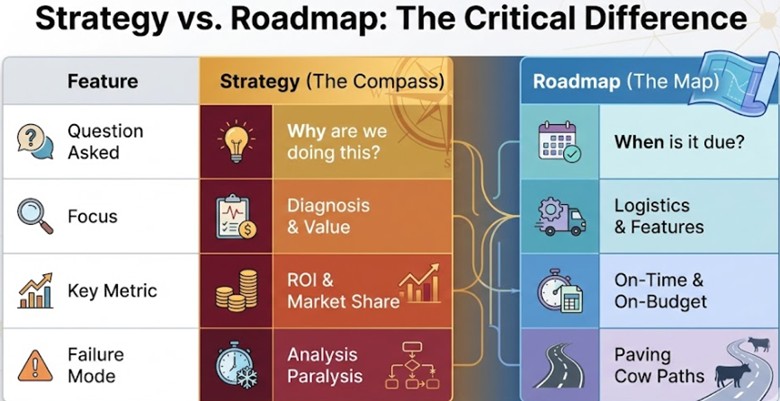 The Clarity Matrix
If you have a roadmap without a strategy, you are essentially "paving cow paths." You are taking your existing, inefficient, analog processes and wrapping them in expensive digital coating. You will process bad data faster. You will make bad decisions with higher resolution. You will fail, but you will do it in the cloud.
The Cost of the "Shopping List" Approach
When you treat a shopping list as a strategy, you introduce Value Leakage. This is the silent killer of ROI.
I worked with a manufacturing client who spent $15 million "digitizing" their supply chain. They bought the best software. They hired the best integrators. Two years later, their inventory costs hadn’t dropped a cent.
Why?
Because their strategy was "Buy Oracle." Their problem was that their regional managers were incentivized to hoard inventory to hit monthly bonuses. The software didn't fix the incentive structure; it just gave the managers a better dashboard to hide their hoarding.
If they had started with strategy, the diagnosis would have been: "Our incentive structure conflicts with our efficiency goals." The guiding policy would have been: "Shift to global inventory visibility and shared bonuses." Only then would the software (the roadmap) have mattered.
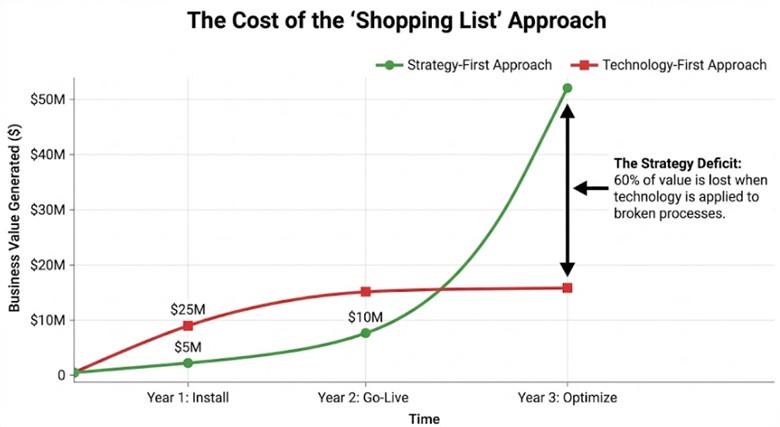 The Value Leakage Gap
The 3 Components of a Real Strategy
To fix this, we need to strip away the buzzwords. I rely heavily on Richard Rumelt’s framework from Good Strategy/Bad Strategy. A functional Digital Strategy must have three specific components before you ever talk about software vendors.
1. The Diagnosis: "What is actually happening?"
This is the most painful part. You have to admit what is broken. A diagnosis simplifies the overwhelming complexity of reality into a single, critical challenge.
Bad Diagnosis: "We need to modernize." (Too vague).
Good Diagnosis: "Our siloed customer data prevents us from cross-selling, causing us to lose 15% of annual revenue to agile competitors."
Notice that the good diagnosis doesn't mention technology yet. It defines the business obstacle.
2. The Guiding Policy: "How do we deal with it?"
This is the guardrail. It is the overall approach chosen to cope with the obstacle identified in the diagnosis. It channels action in a specific direction.
Bad Policy: "We will become a digital-first company." (Fluff).
Good Policy: "We will shift from channel-specific sales teams to a unified 'One-Customer' model, enforcing a single source of truth for all client data."
This policy rules out certain actions. It says "No" to disparate spreadsheets. It says "No" to regional data fiefdoms.
3. Coherent Action: "What do we do now?"
This is where the roadmap lives. These are the specific, coordinated steps (and software) that execute the policy.
Action: Implement a centralized CRM (Salesforce/HubSpot).
Action: Rewrite incentive plans for sales staff to reward cross-channel collaboration.
Action: Cleanse master data to support the "One-Customer" view.
Do you see the difference? In the "Shopping List" approach, the CRM implementation is the goal. In the "Rumelt" approach, the CRM is just one of three coordinated actions designed to solve a specific diagnosis.
The "Vendor Removal" Test
So, how do you know if your current deck is a strategy or a shopping list? I have a simple test for you.
Go to your 50-page presentation. Take a black marker (or the delete key) and remove every single proper noun related to a vendor. Delete "SAP." Delete "Microsoft." Delete "AWS."
Now, read what is left.
Does it still describe a plan to win?
If the text reads like a coherent plan to change how your company creates value (e.g., "We are unifying our supply chain to reduce lead times by 20%"), then congratulations. You have a strategy. The vendor was just the tool.
If the text is suddenly empty, or just a list of dates and generic "optimization" buzzwords, then you don't have a strategy. You have a dependency.
The Verdict
Digital Transformation is not about shopping. It is about solving.
Technology is incredible leverage, but leverage works both ways. If you apply leverage to a cracked foundation, you don't build a skyscraper—you just crack the foundation faster.
If you are a CIO, a CDO, or a Transformation Lead, stop hiding behind the roadmap. Pause the purchase orders. Go back to the whiteboard. Ask the hard questions about friction, culture, and value.
Diagnose the illness before you prescribe the pills.